





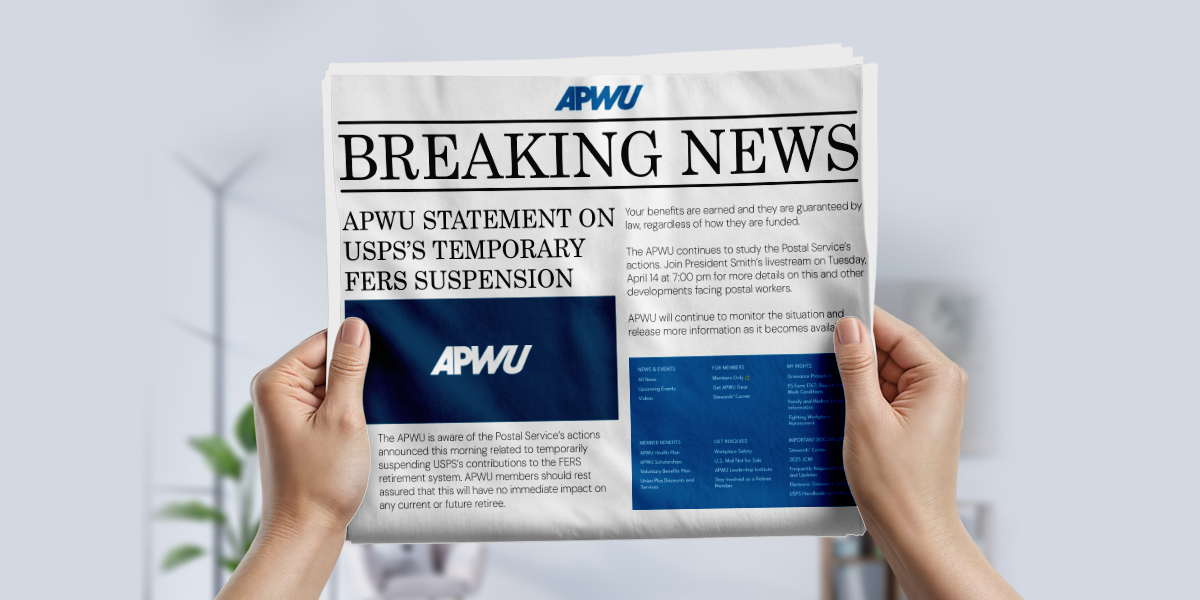
Imagine waking up on a Thursday morning, pouring your coffee, and reading a headline that says the organization you’ve dedicated 20, 25, maybe 30 years of your life to has just stopped funding your pension. No warning call. No town hall first. Just a formal statement to the Office of Personnel Management and a press release that rippled through every union group chat in the country before most people had finished breakfast.
That’s exactly what happened on April 9, 2026, when the United States Postal Service announced it would temporarily suspend its employer contributions to the Federal Employees Retirement System (FERS) — effective the very next day.
If you’re a postal worker, federal employee, or retiree — especially here in Puerto Rico, where thousands of families depend on federal employment for their financial foundation — you deserve a clear, honest, and thorough explanation of what this means, what it doesn’t mean, and most importantly, what you should be doing about it right now.
What Exactly Is the USPS FERS Suspension? Full Breakdown
The USPS Board of Governors announced on April 9, 2026, that the Postal Service would temporarily suspend its employer contributions for the defined benefit portion of FERS, effective April 10, citing an ongoing, severe financial crisis in which the agency could run out of cash as early as February 2027.
To understand why this matters — and why it doesn’t mean what the worst headlines are suggesting — you need to understand what FERS actually is and what portion of it is being paused. FERS is a three-component retirement system used by most federal employees, including postal workers. It is made up of a defined benefit pension (the FERS annuity), the Thrift Savings Plan (TSP), and Social Security benefits. The USPS announcement affects only one of those three components: the employer-side funding of the FERS annuity. Your TSP matching, your Social Security contributions, and your personal payroll deductions into FERS — all of those continue without interruption.
According to USPS, the agency pays approximately $200 million every other week to OPM for the FERS annuity. Suspending those payments, effective April 10, is expected to free up approximately $2.5 billion before the end of the current fiscal year on September 30, 2026.
What Is the FERS “Three-Legged Stool” and Why Does It Matter to Postal Employees Right Now?
Federal retirement planning professionals often refer to FERS as a “three-legged stool” — a structure that only holds weight when all three legs are intact and working together. Understanding each leg is critical to understanding why this suspension, while serious in context, is not an immediate threat to your retirement income.
Leg 1: The FERS Annuity — The Leg That’s Being Tested
The FERS annuity is the defined benefit pension portion of federal retirement. Your eventual monthly payment is calculated based on your years of creditable service, your “High-3” average salary (the highest consecutive three years of your base pay), and a multiplier of 1% — or 1.1% if you retire at age 62 or later with at least 20 years of service. This is the leg where employer contributions are temporarily suspended. However, it’s important to understand that your future pension calculation is not tied to whether the employer made contributions on time — it’s tied to your service years and salary, both of which remain unchanged.
Leg 2: The TSP — Your Market-Based Growth Engine, Still Fully Funded
The Thrift Savings Plan operates like a federal version of a 401(k) and is entirely separate from the FERS annuity funding mechanism. USPS will continue to make the automatic 1% contribution and the up-to-5% matching contributions to TSP. This is an important distinction, since the TSP is a defined contribution plan that must be funded right away to be effective. Every dollar you contribute to your TSP from your paycheck is still being matched — and that free matching money is one of the most powerful wealth-building tools available to any federal worker. If you are not contributing enough to capture the full USPS match, this is the moment to fix that.
Leg 3: Social Security — Unchanged and Fully Active
Social Security contributions for all USPS employees covered under FERS continue exactly as before. The FERS suspension has no bearing on your Social Security benefit calculation or your eligibility timeline. For many postal workers, Social Security will represent a meaningful portion of monthly retirement income — particularly for those who retire before age 62 and need bridge income until full benefit age. Keeping this leg strong means continuing to earn Social Security credits throughout your working years, which the suspension does not interrupt.
What FERS Benefits Are Still Fully Protected for USPS Employees During the Suspension?
Service Credit Remains Fully Protected
Federal employees can feel reassured knowing their retirement service time continues to accumulate without interruption. Even during this temporary suspension, every day worked still counts toward your pension calculation, preserving the integrity of your long-term benefits.
No Impact on Current Retirees’ Annuity Payments
For those already retired, monthly pension payments remain unchanged. Retirement income is distributed through a separate administrative system, ensuring that any employer-side funding adjustments do not interfere with your steady annuity checks.
TSP Contributions and Matching Stay Intact
Your Thrift Savings Plan remains one of the most stable parts of your retirement. Employee contributions continue as usual, and employer matching is still being applied, making it a critical tool to maximize during uncertain periods.
CSRS Benefits Are Completely Unaffected
Individuals under the Civil Service Retirement System are not impacted by this situation. Since it operates independently from FERS, all CSRS retirement benefits and structures remain exactly as they were, with no changes whatsoever.
Read More: Judge Directs VA to Reinstate AFGE Contract: Impact on Federal Workers
How to Maximize Your TSP While Everything Else Sorts Itself Out
Since your TSP matching contributions were not touched by this suspension, your most actionable move right now is to ensure you are extracting maximum value from what is still fully working.
The 2026 TSP contribution limit is $23,500 for employees under age 50. For those 50 and older, catch-up contributions raise that limit to $31,000 total. If you are not contributing at least 5% of your base pay, you are leaving employer match money unclaimed — and in a period of institutional uncertainty, that is the one form of guaranteed return available to every USPS employee regardless of what Congress does next. Review your TSP fund allocation as well. Many postal workers set their allocations years ago and have never revisited them. As you approach retirement, your risk tolerance and investment timeline shift — and your fund mix should reflect that.
What This Means for Postal Workers and Federal Employees Living in Puerto Rico
For the tens of thousands of USPS workers and federal employees across Puerto Rico — from San Juan to Ponce, Caguas to Bayamón — this suspension carries the same legal and structural implications as it does for workers on the mainland.
What makes Puerto Rico unique is the context. Federal employment has long been one of the most dependable paths to middle-class stability, offering benefits and retirement security that many private-sector roles cannot match. This makes protecting and optimizing your federal benefits a generational priority. At PWR Retirement Group, we serve clients across Puerto Rico and all 50 states with education-first guidance. If you are seeking the best financial advisor for federal employees, it starts with understanding your options before making any decision.
5 Action Steps Every USPS and Federal Employee Should Take
Step 1:
Log into your Thrift Savings Plan account, confirm contributions and matching, review fund allocations (G, F, C, S, I, or L Funds), and update beneficiaries to ensure your most flexible retirement asset is functioning properly.
Step 2:
Request a retirement estimate from Office of Personnel Management or HR to understand your projected FERS annuity based on service years and High-3 salary, helping you plan realistic retirement income expectations.
Step 3:
Stay connected with unions like American Postal Workers Union, NALC, NPMHU, and NRLCA for timely updates on legislation, benefits, and USPS changes impacting your retirement security and future planning decisions.
Step 4:
Evaluate whether your retirement income relies solely on federal systems or includes diversified sources like tax-advantaged strategies, insurance-based solutions, and supplemental income streams to protect against inflation, healthcare costs, and long-term financial uncertainty.
Step 5:
Schedule a consultation with a qualified financial professional experienced in FERS and TSP planning to review your full retirement picture and align your strategy with long-term goals, income needs, and risk management.
Stay informed as developments unfold. The APWU continues to study the Postal Service’s actions. Join President Smith’s livestream on Tuesday, April 14 at 7:00 pm for more details on this and other developments facing postal workers.
Read More : Complete Guide to FEGLI for Federal Employees in 2026
Frequently Asked Questions: USPS FERS Suspension 2026
Is my FERS pension being cancelled because of the USPS suspension? No. The suspension applies only to the employer’s funding contribution to OPM. Your FERS benefit formula, your service credit, and your projected annuity are all unchanged.
Will USPS stop matching my TSP contributions during the suspension? No. TSP matching — including the automatic 1% and up to 5% matching — continues in full and is explicitly protected under the USPS cash conservation plan.
Does the FERS suspension affect my years of service count? No. A legal opinion from the Office of Legal Counsel confirms that service credit accumulation continues normally during the suspension period.
Did USPS do this before? Yes — in June 2011, USPS suspended FERS employer contributions during a prior financial crisis, resumed payments after several months, and repaid what was owed to OPM.
How long will the suspension last? USPS has not specified an end date. The suspension is tied to the broader financial restructuring and Congressional action timeline.
Wrapping Up
The real takeaway is simple: your pension is not at risk today, but this moment is a clear reminder that relying on a single source for retirement security carries long-term risk. The most prepared federal employees are not reacting with fear — they are using this as an opportunity to reassess their strategy, strengthen what is working, and build additional income streams that create stability beyond government benefits.
If you are a federal employee, veteran, or postal worker, working with the right guidance means choosing someone who understands FERS, TSP, and OPM benefits in depth. At PWR Retirement Group, our philosophy is clear: Learn Today. Retire Smart — so you are prepared long before uncertainty arises. If you are ready to take the next step, submit your Request For Consultation and gain clarity on your complete retirement strategy.